
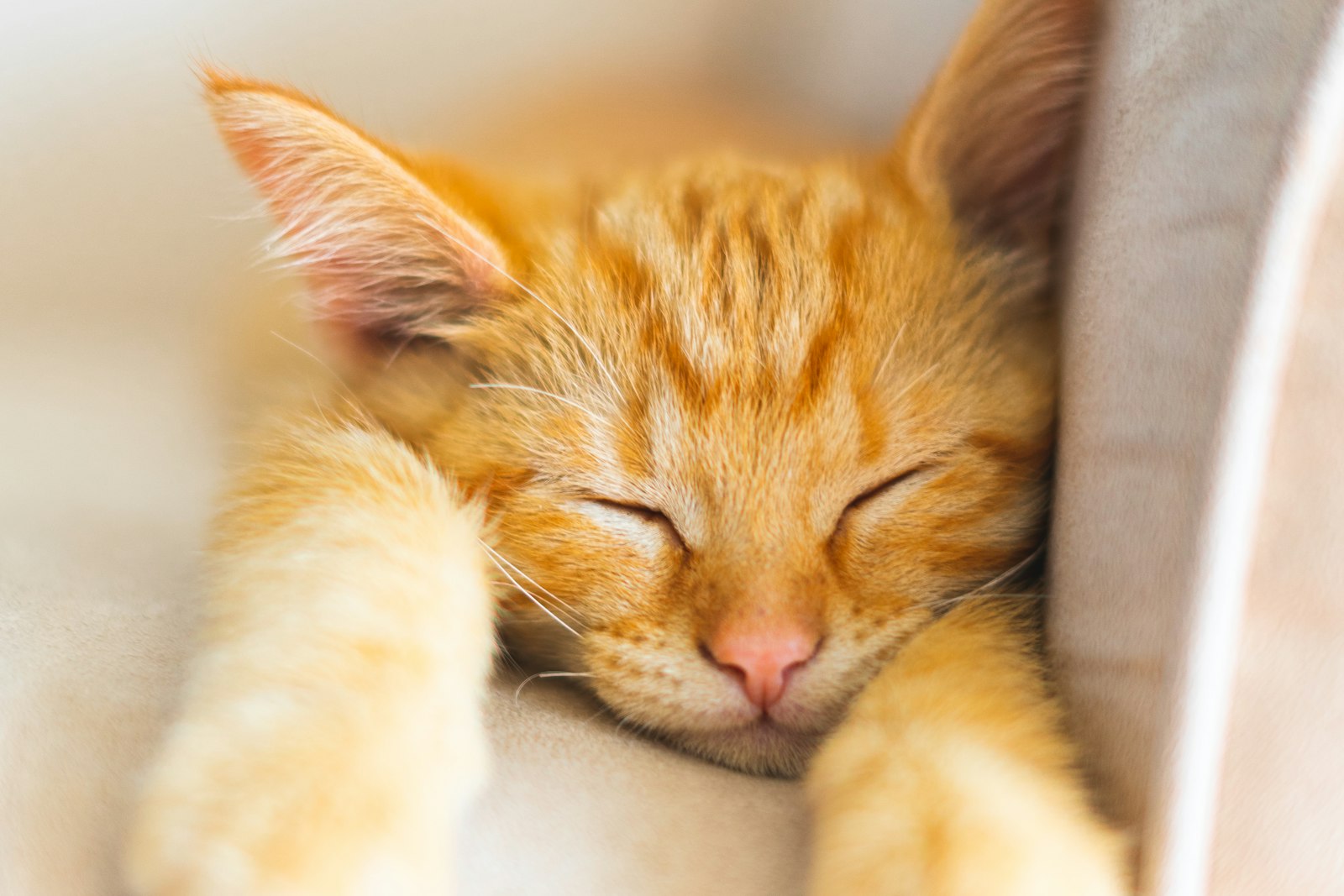
For roughly four thousand years, people have credited cats with something more than pest control. The claim recurs across cultures with a persistence that is itself interesting, and it has recently been given a modern gloss: the idea that a cat’s purr sits in a frequency range that heals tissue.
That is a claim worth examining properly, because the honest version is more interesting than the marketing version.
The historical record
In ancient Egypt, cats occupied a position no other domestic animal held. The goddess Bastet, depicted with a lioness or cat head, was associated with protection of the home, and cats were mummified in enormous numbers as votive offerings. The often repeated detail that killing a cat carried a severe penalty comes from Greek sources writing about Egypt rather than Egyptian legal texts, so it should be held loosely, but the archaeological record on its own is unambiguous about the status these animals had. The pattern is not confined to Egypt. Cats appear as threshold guardians in Norse material through their association with Freyja, as temple protectors in Japan where the beckoning cat figure still sits in shop windows, and as favoured household animals in Islamic tradition, where a well known body of narrative treats kindness to cats as a virtue. In medieval Europe the associations turned, and cats acquired a link with witchcraft that cost a great many of them their lives.
What all of this tells us is cultural rather than physiological. Across very different societies, people have consistently perceived cats as occupying a threshold: between domestic and wild, visible and hidden, ordinary and something else. That perception is real and old. It is not evidence of a healing mechanism.
The purr claim, examined
The specific modern claim goes like this: cats purr between roughly 25 and 150 Hz, and vibration in that range has been shown to stimulate bone density and tissue repair, therefore a purring cat on your lap is doing therapeutic work.
Here is where that comes from. A 2001 conference presentation to the Acoustical Society of America recorded purrs from 44 felids, including cheetahs, ocelots, pumas and domestic cats, and reported strong frequencies between 25 and 150 Hz. The author noted that this range overlaps with frequencies used in vibration therapy for bone and tissue.
Notice what that study did and did not do. It measured the frequency of purrs. It observed an overlap with a separate body of research on vibration platforms used on people. It did not test whether a purring cat produces any effect in a human being, and no study since has done so. The two research literatures sit side by side and have never been joined.
There are further complications. Vibration platform research on humans has produced mixed results, with some large trials finding no change in bone density. And the amount of mechanical energy transmitted by a cat lying on a chest is not comparable to a clinical vibration device, which is the point most retellings skip past.
So the accurate statement is: the frequency observation is real, the leap from it to human healing is not supported, and anyone selling you the leap is selling you something.
What is actually there
Which leaves the question of why the association persists, and here the answer is more ordinary and more solid.
The research on companion animals and wellbeing is genuinely mixed, and honest summaries say so. A 2022 systematic review of pet ownership, loneliness and social isolation found that ownership was associated with lower social isolation in adults, while the loneliness findings were inconsistent and only became clearer during the pandemic period. A 2025 systematic review and meta analysis of pet ownership and depression covering more than 159,000 participants found no overall significant association, and reported a more complicated picture for cats specifically. Reviews of attachment rather than ownership tend to find stronger relationships, which points at something sensible: what matters is not whether an animal is present but the quality of the bond.
None of this makes a cat a therapeutic intervention. It makes a cat a relationship, and relationships are not nothing.
There is also the mundane and underrated part. A cat imposes rhythm on a household. Someone has to be fed at a particular hour. Someone comes and sits on you and does not leave when you shift position, which enforces a period of stillness that most people would not otherwise take. Someone is present when you come home. For a person living alone, or moving between cities, that structure is worth more than most of the frequency arguments.
The reasonable position
Cats have carried symbolic weight in human societies for millennia, and that history is worth knowing on its own terms. The purr is a genuinely unusual sound with a genuinely unusual frequency profile. What is not established, and should not be claimed, is that a cat treats anything.
If a cat on your lap settles you, that experience is real and needs no mechanism to justify it. And if you are dealing with a health concern, that belongs with a doctor, not with a cat and not with any complementary practice, this one included.
References
- 01von Muggenthaler, E. (2001). The felid purr: A healing mechanism? Journal of the Acoustical Society of America, 110(5), 2666
- 02Kretzler, B., König, H. H., & Hajek, A. (2022). Pet ownership, loneliness, and social isolation: a systematic review. Social Psychiatry and Psychiatric Epidemiology, 57, 1935– 1957
- 03Pet ownership and risk of depression: a systematic review and meta-analysis (2025). Annals of General Psychiatry
- 04The Relationship Between Attachment to Pets and Mental Health and Wellbeing: A Systematic Review (2025). Animals, 15(8), 1143
This article is for general information and does not constitute medical advice. Bioenergy work is a complementary wellbeing practice and is not a substitute for medical diagnosis or treatment. If you have a health concern, please speak to your GP.